
All You Need to Know to Create a Healthcare Marketing Plan

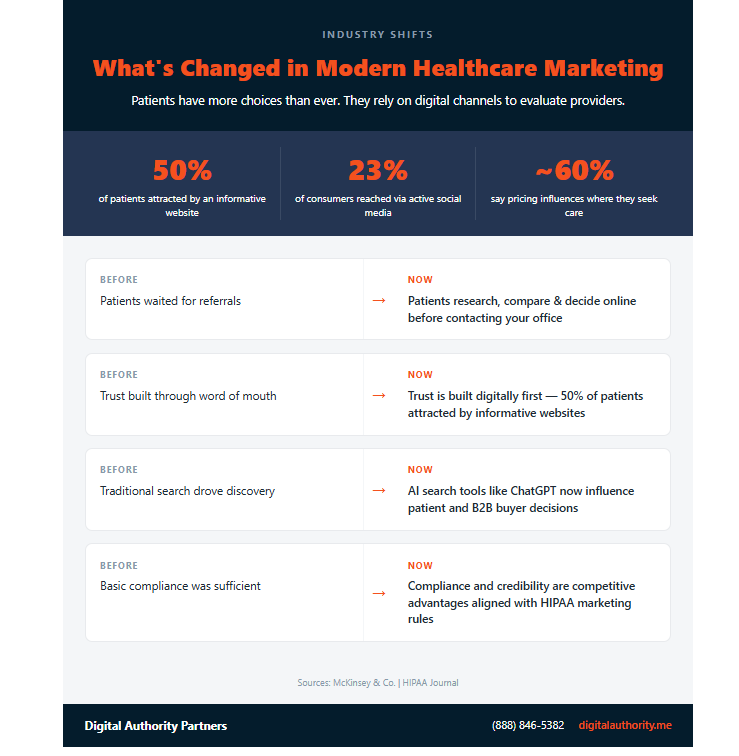
Your patients are browsing reviews, comparing prices, and asking AI tools for healthcare advice before they ever contact your office. This shift toward ownership in personal healthcare is accelerating. An informative website attracts 50% of patients, and an active social media presence reaches 23% of consumers.
A strategic healthcare marketing plan helps you meet these patients where they already search and decide. Expert healthcare digital marketing agencies help organizations like yours build compliant plans that drive engagement and measurable growth. This guide covers seven essential elements to strengthen your strategy.
How a Healthcare Marketing Plan Supports Growth
Patients rely on digital channels to evaluate providers, making differentiation and consistency critical to your success. A comprehensive healthcare digital marketing strategy positions your organization to meet patients where they already search, compare, and decide.
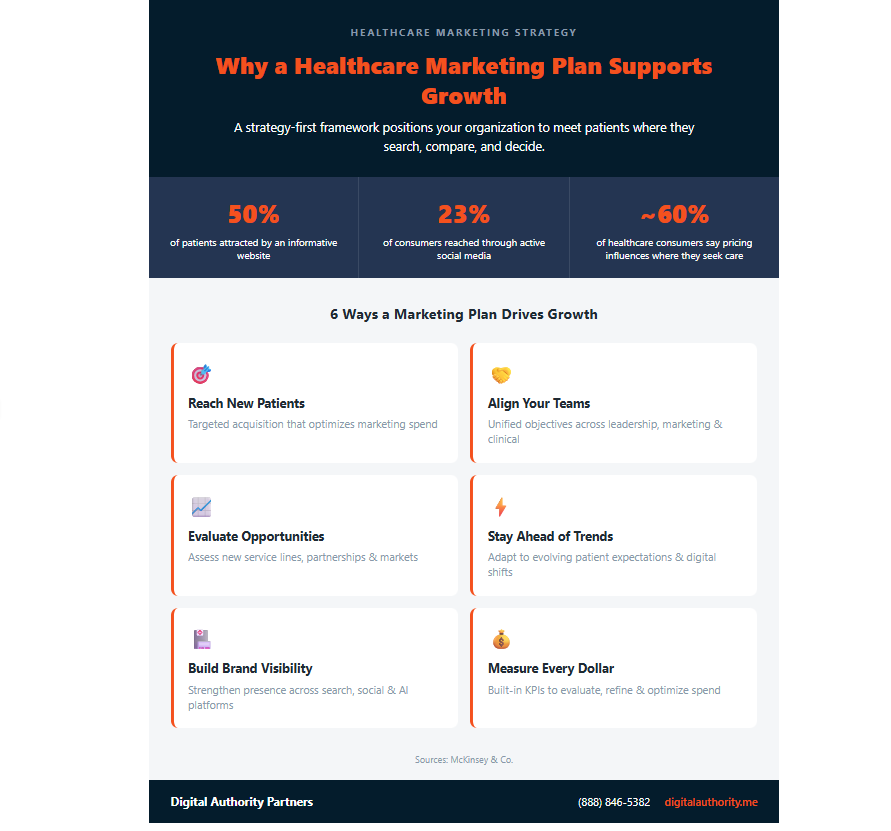
A well-defined marketing plan for healthcare services turns that positioning into measurable results. When paired with a clear budget and timeline, strong healthcare marketing ideas help you increase patient volume, retain existing customers, and improve your return on investment. A structured framework also creates accountability, so your team can track what works and adjust what needs refinement.
Here is how a healthcare marketing plan supports your organization’s growth:
- Reach new patients faster and cost-efficiently: A targeted acquisition strategy helps you meet your expansion goals while optimizing your marketing spend.
- Align your teams around shared priorities: A unified marketing objective streamlines decision-making and keeps leadership, marketing, and clinical teams working toward the same outcomes.
- Evaluate new growth opportunities with confidence: A clear strategic framework helps you assess new service lines, partnerships, or markets and make informed decisions quickly.
- Stay current with healthcare marketing trends: A proactive marketing plan keeps your brand aligned with groundbreaking healthcare marketing trends and evolving patient expectations.
- Build a visible, trusted healthcare brand: Patients increasingly discover providers online, so your plan should support visibility across search, social, and AI-driven platforms.
- Measure the impact of every marketing dollar: Built-in performance indicators give you a framework to evaluate, refine, and optimize how you allocate your budget.
- Define clear goals and a strategic roadmap: Documented priorities and execution paths give your practice a clear direction for sustainable growth and diversification.
Do these priorities align with your current objectives? Whether you operate a B2C practice or pursue B2B healthcare marketing partnerships, a structured plan shapes your growth with precision. Preparation gives you confidence, so you know when to act on a new opportunity.
What Should a Comprehensive Healthcare Marketing Plan Include?
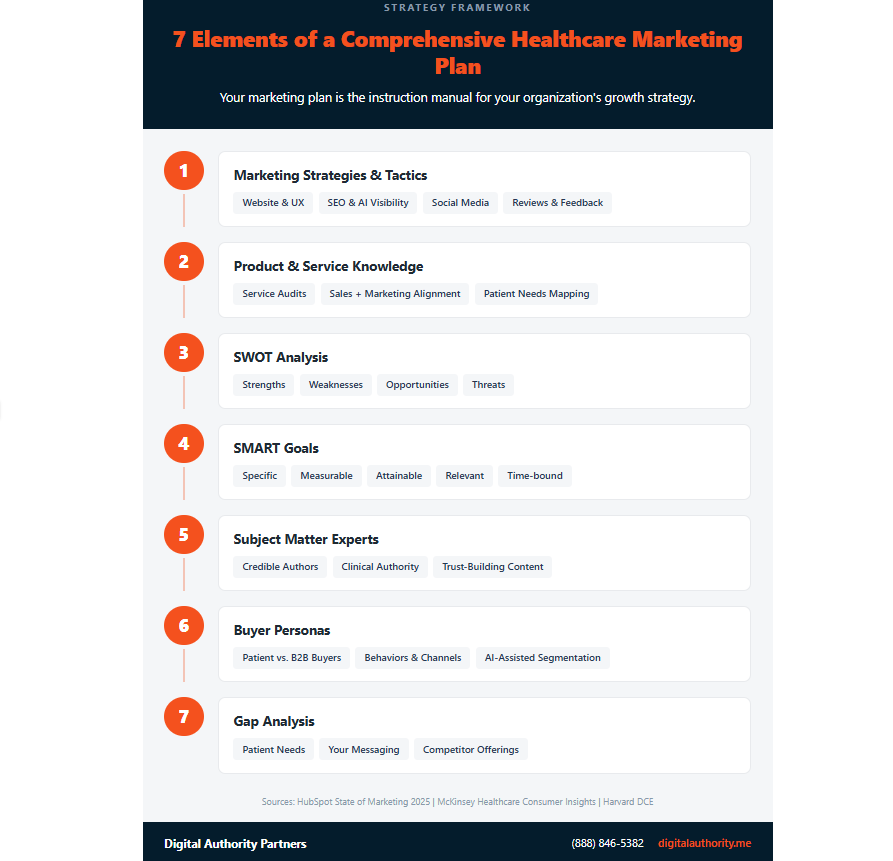
Think of your marketing plan as the instruction manual for your organization’s growth strategy. It should help your marketers understand your business objectives, know what is expected of them, and see how their work connects to broader organizational goals. The following seven elements form the foundation of a well-rounded marketing plan for healthcare services:
1. Healthcare Marketing Strategies That Drive Engagement
Clearly defined marketing and PR strategies should anchor your healthcare marketing plan. The criteria for patient satisfaction in the digital age have transformed significantly. Your patients expect healthcare facilities to offer more than quality treatment. They want engagement, transparency, and convenience at every touchpoint.
According to McKinsey & Co., patients and healthcare consumers expect a high level of service throughout their care journey. Almost 60% of healthcare consumers report that pricing influences where they seek care. Healthcare marketing strategies that anticipate these expectations keep your patients confident in your brand and position your organization as responsive to their priorities.
Your tactics should go beyond a simple promotional calendar. They represent a long-term investment in patient retention and volume growth. Here are the core healthcare marketing ideas that strengthen a comprehensive plan:
- Build a user-friendly and mobile-responsive website: Your site should impress prospective patients with expert execution and intuitive navigation that makes it easy to find providers, book appointments, and access health resources.
- Implement an SEO strategy to increase your website’s visibility: Search engine optimization (SEO) uses various methods to improve your website’s ranking on traditional search engines, helping patients find you when they search for care.
- Develop a social media framework in your marketing plan: A social media presence for healthcare builds your reputation and extends your reach. Leverage paid advertising and analytics tools for additional exposure and audience insights.
- Establish a patient feedback process: Outline a systematic approach for collecting and responding to patient feedback to strengthen your brand reputation and continuously improve the patient experience.
- Collect and promote patient reviews: Ratings serve as a powerful marketing tool in your overall promotion strategy. Actively request reviews from satisfied, consenting patients and feature them across your digital channels.
- Optimize for artificial intelligence (AI) search: Content cited by AI-search tools, such as ChatGPT, answers health-related questions for patients and B2B healthcare marketing buyers. Generative engine optimization aligns your content for AI visibility and positions your expertise in front of a growing audience.
- Standardize your branding across all channels: Incorporate personality-led branding into your healthcare digital marketing strategy to establish authenticity and trust at every patient touchpoint.
Once you’ve implemented these customer-focused healthcare marketing strategies, the next step is to ensure your marketing team has deep familiarity with the products and services they are promoting.
2. Product Knowledge That Strengthens Your Marketing Plan
Your healthcare marketing plan becomes more effective when your team understands the full scope of your services and products. Detailed knowledge of your brand’s offerings supports a more targeted, results-oriented approach to practice or hospital marketing, whether you serve individual patients or focus on B2B healthcare marketing partnerships.
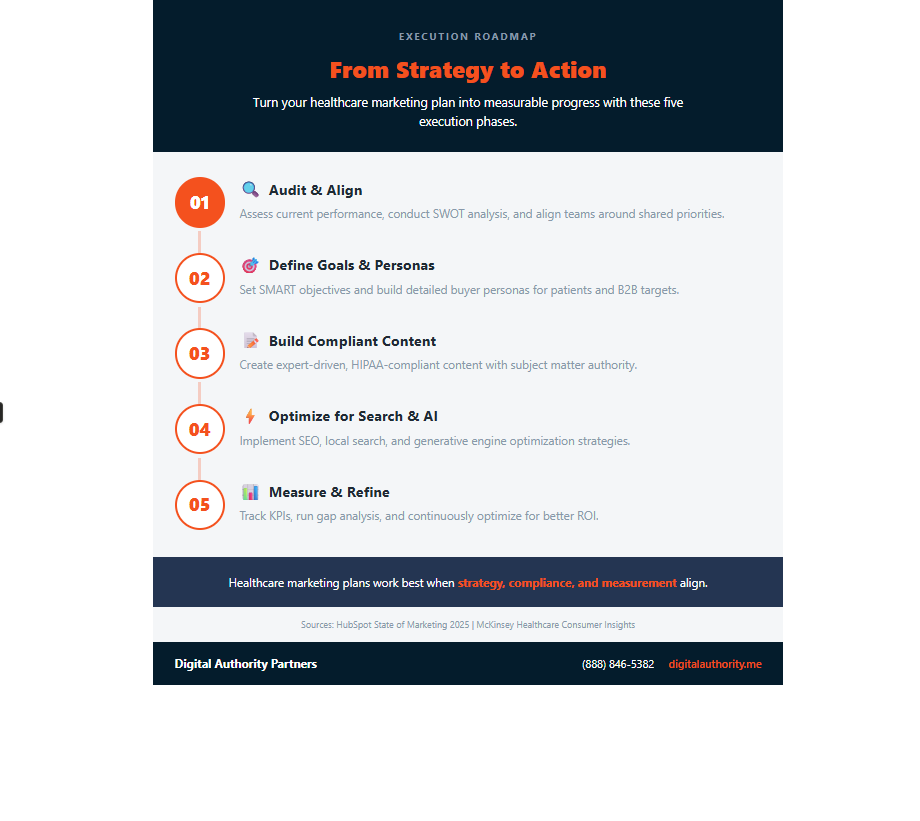
Start by conducting a thorough audit of your services and products. Speak to the sales team. When marketing and sales coordinate around the same patient persona and revenue goals, your promotions become more precise and authentic. Who is your target patient or B2B buyer? What are they looking for in healthcare services? How can you support their healthcare autonomy? A clear understanding of your offerings and how your audience perceives your brand positions you to market with accuracy and confidence.
With a solid foundation of product knowledge in place, you are ready to assess your competitive landscape. A SWOT analysis builds on this understanding by mapping your organization’s position against market realities.
3. SWOT Analysis to Outline Your Market Position
SWOT, short for Strengths, Weaknesses, Opportunities, and Threats, is an analytical framework that elevates your healthcare marketing preparation. It means evaluating crucial elements that shape the direction of your marketing plan for healthcare services. Strengths are capabilities that give you a competitive edge, such as:
- New or differentiated services and products that distinguish your practice
- Specialized clinical expertise that reinforces your authority
- A strategic location that improves accessibility and visibility
- Established procedures and quality standards that ensure consistency
- Valuable business assets that enhance your overall service offering
Weaknesses highlight areas with room for growth and can reveal opportunities to strengthen your specialty relative to your market. Your SWOT analysis may surface opportunities for location optimization, staffing development, reputation enhancement, expanded service awareness, and strategic navigation of external market factors.
Opportunities may include adopting new technologies or services, forming partnerships, or expanding into emerging healthcare sectors. Shifts in patient needs, population trends, or competitive dynamics can create openings to reach new patients or focus on higher-value services.
Threats are external factors worth monitoring, so your team can respond proactively. Common external factors in the healthcare sector include new market entrants, evolving technology, regulatory updates, economic shifts, and competitive pricing dynamics. Recognizing these factors early keeps your healthcare marketing strategies agile and forward-looking.
A SWOT analysis should provide a realistic, honest picture of your current business position to inform both B2C and B2B healthcare marketing efforts. With that assessment complete, you can translate your findings into specific, actionable targets.
4. Healthcare-Specific SMART Goals
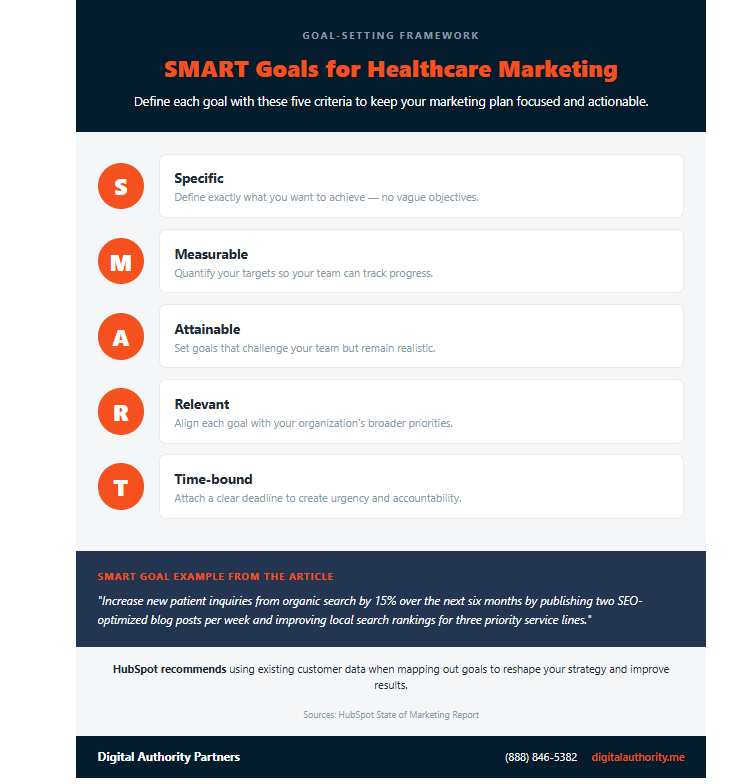
SMART stands for Specific, Measurable, Attainable, Relevant, and Time-bound. Defining each goal with these criteria keeps your healthcare marketing plan objectives clear, focused, and actionable. Your team gains detailed, measurable targets to work toward, and leadership gains a framework for tracking progress.
Setting SMART goals also means accounting for shifting patient and buyer expectations. A State of Marketing Report from HubSpot recommends using existing customer data when mapping out goals. Rethinking your healthcare digital marketing approach and channel mix based on established patient preferences and relationships can reshape your strategy and improve results.
For example, instead of a vague objective like “get more patients,” a SMART goal would read: “Increase new patient inquiries from organic search by 15% over the next six months by publishing two SEO-optimized blog posts per week and improving local search rankings for three priority service lines.”
Once your SMART goals are in place, identify the subject matter experts within your organization who can lend clinical authority to your content marketing efforts.
5. Subject Matter Experts to Strengthen Healthcare Content
Today’s ease of researching symptoms and medical concerns means that patients have greater awareness of their conditions. Your patients and B2B buyers want credible, high-quality information from expert authors, and search engines reward content that demonstrates firsthand expertise.
Subject matter experts play a central role in creating impactful healthcare marketing ideas and campaigns. When you need authoritative content for a specific service line, your in-house specialists bring the credibility your audience expects. For instance, if you are looking to grow your cardiac patient volume, a well-known cardiologist on your team can draft the thought leadership piece that resonates with both patients and referring physicians.
Build a roster of in-network physicians and other key experts in healthcare marketing to advance your healthcare marketing strategies. Author credibility is essential for Google’s quality metrics and increasingly important for AI search platforms that prioritize expertise signals.
With your expert contributors identified, turn your attention to understanding who your marketing is designed to reach. Well-defined buyer personas ensure your healthcare marketing strategies connect with the right audience.
6. Buyer Personas to Segment Your Audience
Segmenting your audience can significantly strengthen your healthcare marketing plan. Start by clearly defining your buyer personas through top-down market and competitor research to gain insights into your typical patient or B2B buyer.
A measured examination of reported outcomes combined with machine-learning analysis of customer segments can help you refine your healthcare marketing ideas. Your research should include a closer look at your existing patients, a review of market trends, and an analysis of the channels where your customers discover you. Go the extra mile to understand your patients’ treatment preferences or your B2B buyers’ technology priorities.
Your practice can use AI to identify patient and customer segments, based on health data, engagement behaviors, personalized care needs, and healthcare outcome patterns. A highly targeted buyer persona then guides your content creation, supporting your marketing teams as they develop healthcare marketing strategies tailored to each segment. For organizations with a defined set of high-value targets, account-based marketing in healthcare adds another layer of precision by aligning sales and marketing efforts around specific accounts rather than broad audiences.
With your personas clearly defined, the final step in building a comprehensive marketing plan for healthcare services is to conduct a gap analysis that measures where you stand against where you want to be.
7. A Healthcare Marketing Gap Analysis to Reveal Opportunities
A gap analysis helps you align your services with patient needs by identifying areas for improvement and opportunity. This process examines your current healthcare marketing strategies and assesses what you may need to do to accomplish your target outcomes, often by benchmarking against competitor actions.
A medical study on mass health emergencies identified accurate information and consistent messaging as key factors in effective healthcare communication. Conveying trustworthy medical advice is essential to patient confidence and an important step in aligning with state and national healthcare marketing regulations. An expert healthcare marketing leader helps your team align gap analysis findings with compliance requirements.
Your gap analysis reveals which healthcare digital marketing approaches deliver results for your bottom line and which ones are ready for optimization. These insights inform your account-based marketing healthcare strategy and spotlight opportunities for greater impact. When you know exactly where the gaps are, you can prioritize the changes that move your organization forward.
Put Your Healthcare Marketing Plan Into Action With Digital Authority Partners
A comprehensive healthcare marketing plan turns strategy into measurable progress. SEO-driven content increases qualified patient inquiries. A focused SWOT analysis sharpens your competitive positioning. SMART goals align your team around the priorities that matter most. Together, these elements form the foundation of healthcare marketing strategies that guide long-term performance and accountability.
Your marketing roadmap reinforces brand credibility and expands your reach when you consistently monitor, measure and refine it. Whether your focus is B2B healthcare marketing or direct-to-patient acquisition, a well-executed plan creates a clear line of sight between your marketing activities and your business outcomes, so you can track progress and adjust strategy based on real results.
Digital Authority Partners develops healthcare marketing strategies and campaigns designed to strengthen your brand and improve return on investment. Contact our team today to turn your healthcare marketing plan into sustainable growth.
Want To Meet Our Expert Team?
Book a meeting directly here

Related Articles

Demand for therapy is at an all-time high, yet nearly half of the 62 million U.S. adults with a mental illness receiv...


AI in digital health has moved from research labs into daily care. A phone camera can now screen for diseases that on...

Nearly every local search ends in one of three spots. The U.S. has 8.3 million business establishments, and 7.1 milli...